
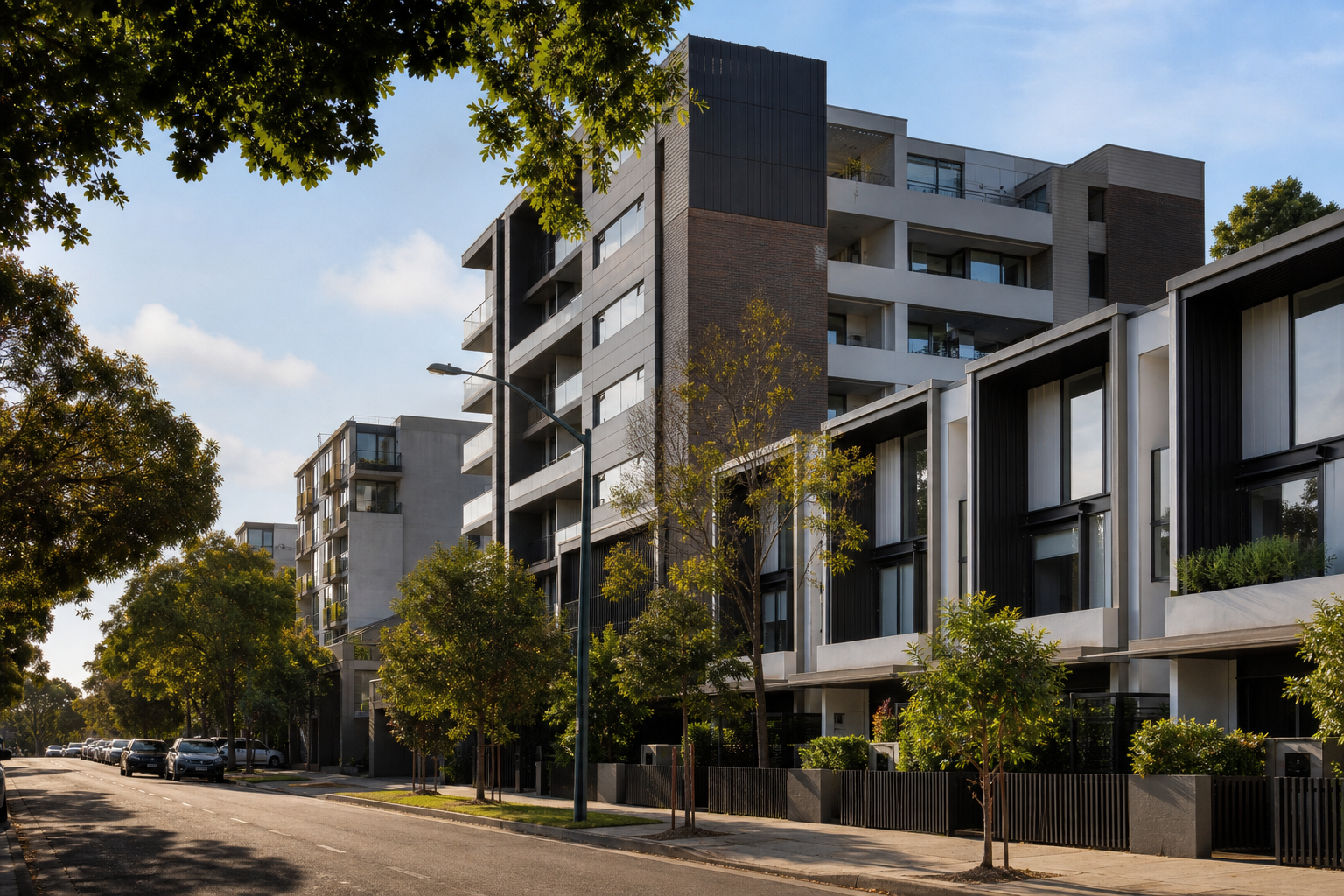
Project Avoca develops across four typologies, each with distinct planning pathways, design priorities, and market dynamics in Victoria.
Choosing the right typology
Site dimensions, zoning, neighbourhood context, and client objectives determine the appropriate development typology. A corner lot in Richmond may suit townhouses; a Southbank podium site favours apartments; a large suburban allotment in Brighton may support a boutique residence. We assess yield, margin, and planning risk for each option before recommending a pathway.
Mixed typologies occasionally arise — ground-floor commercial with residential above, or dual occupancy with flexible configuration. Planning strategy must address use conflicts, acoustic separation, and services design from concept stage.
Market timing influences product selection. Build-to-rent apartment schemes require different finish specifications and management provisions than build-to-sell owner-occupier townhouses in Boroondara.
Apartments
Apartment development in Melbourne faces apartment design standards for daylight, storage, ventilation, and communal amenity. NCC energy and accessibility requirements add complexity. We navigate these while delivering refined interiors and durable common areas that support long-term asset value.
Inner-urban sites in Southbank, Docklands, and Carlton demand attention to wind, overshadowing, and traffic generation. Consultation with neighbours and council officers is often part of the planning pathway.
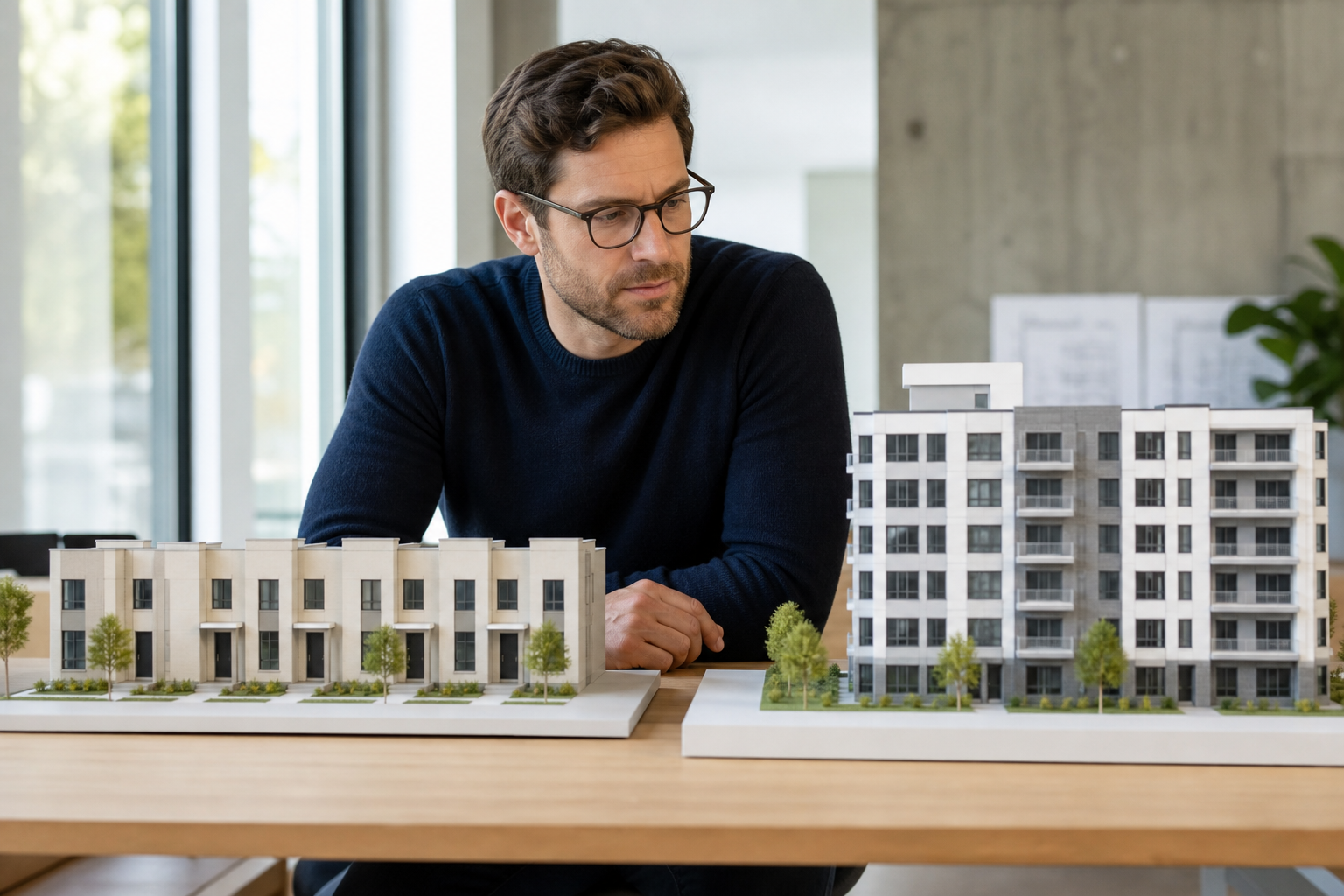
Townhouses and boutique residences
Townhouse and terrace projects suit medium-density residential zones across Merri-bek, Yarra, and Stonnington. Garden area requirements, neighbourhood character policies, and overlooking controls shape design. We achieve yield without sacrificing liveability or streetscape contribution.
Boutique residences serve discerning owner-occupiers seeking architectural distinction in premium suburbs. Lower dwelling counts enable exceptional material and spatial quality unachievable at volume scale.
The right typology is the one the site, planning framework, and market can sustain — not the one that maximises brochure yield.
Commercial development
Select commercial projects — office refurbishments, small-scale commercial buildings, mixed-use podiums — address tenant requirements with institutional delivery standards. Government and corporate tenants demand compliance, documentation, and programme certainty.
Explore each typology in detail via the links below, or contact us to discuss your site.
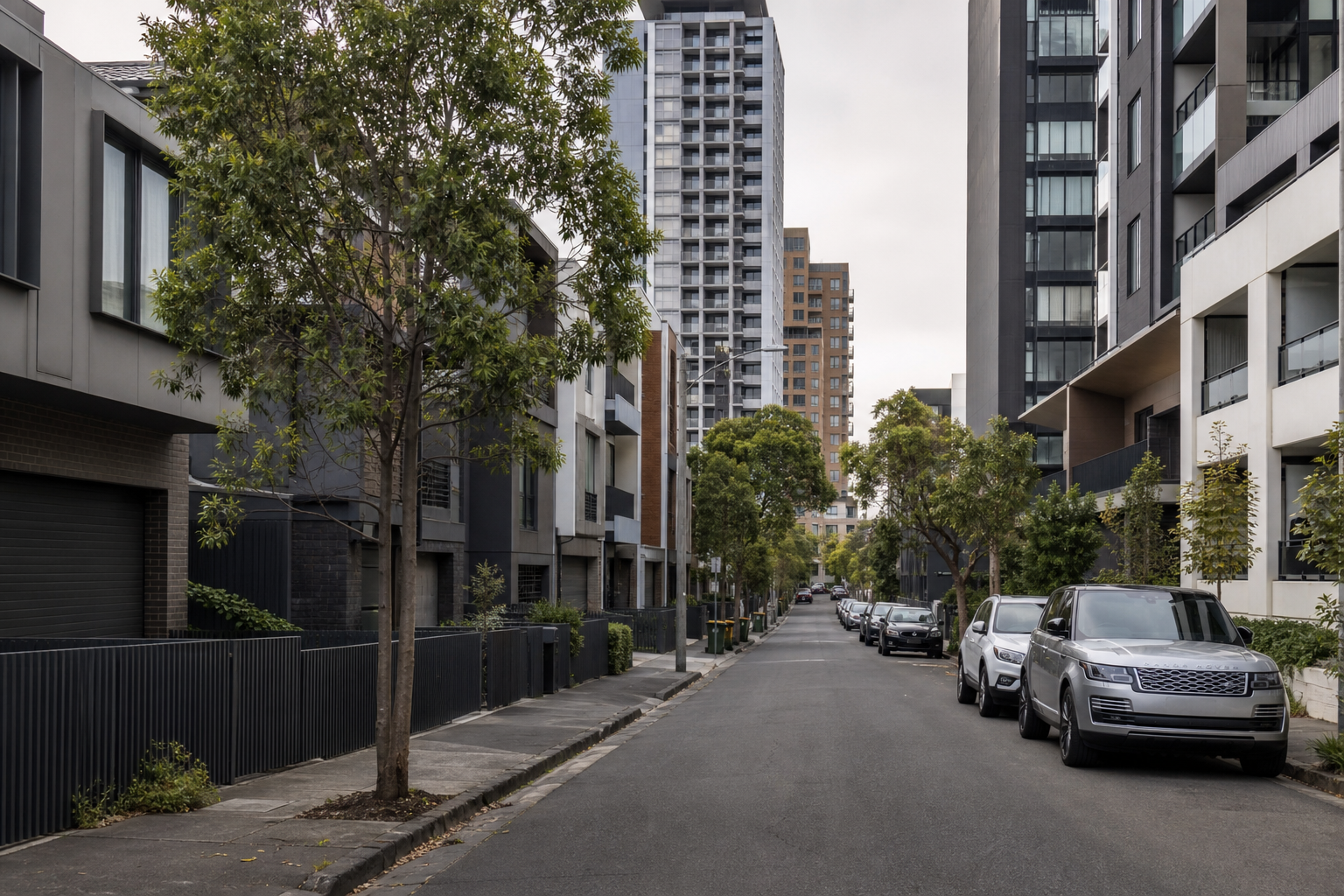
Comparative analysis
When multiple typologies are viable, we present side-by-side feasibility: dwelling count, margin, programme, and planning risk. Landowners make informed choices rather than defaulting to highest theoretical yield.
Build-to-rent typology may favour durable specification and communal amenity weighted differently than build-to-sell. Typology choice is strategic, not merely architectural preference.
Market cycles
Typology preference shifts with interest rates, migration, and rental vacancy. Apartments in inner Melbourne may favour build-to-rent in high-rate environments; townhouses in family suburbs may outperform when apartment oversupply concerns rise. Feasibility refresh at permit issue captures market movement.
Services infrastructure
Typology choice affects services demand. High-density apartment schemes require upgraded drainage and electrical infrastructure negotiated with authorities. Townhouse schemes distribute load but multiply connection points. Feasibility includes authority headworks contribution and lead time.
Contact Project Avoca to compare typology feasibility on your site — we present candid recommendation rather than defaulting to highest density.
We advise on typology selection throughout Victoria.
Design panel and referral pathways
Significant projects in Melbourne may require design panel review or extended council advertising. Typology and massing choices influence whether referral is triggered. Early massing studies test panel-sensitive parameters — height, setback, material — before land price is finalised.
Mixed-use typologies require early resolution of acoustic separation, services metering, and owners corporation structure. Ground-floor commercial with residential above demands fire and accessibility compliance distinct from single-use schemes.
Product positioning
Build-to-sell townhouses in family suburbs emphasise garden, storage, and acoustic privacy. Build-to-rent apartments emphasise durable specification, operational efficiency, and management-friendly common areas. Boutique residences emphasise craft and customisation. Typology and finish strategy follow site context and market position.
Compare typologies on your lot
We run side-by-side feasibility when more than one product could stack up on the same site.
Request a Quote